Despite widespread adoption of zero-trust architectures, advanced endpoint detection, and phishing-resistant MFA, phishing continues to be the most reliable initial access vector for attackers. Industry breach analysis consistently shows that social engineering and phishing are involved in roughly one-third of confirmed data breaches, making them one of the most effective ways to gain an initial foothold in modern environments.¹
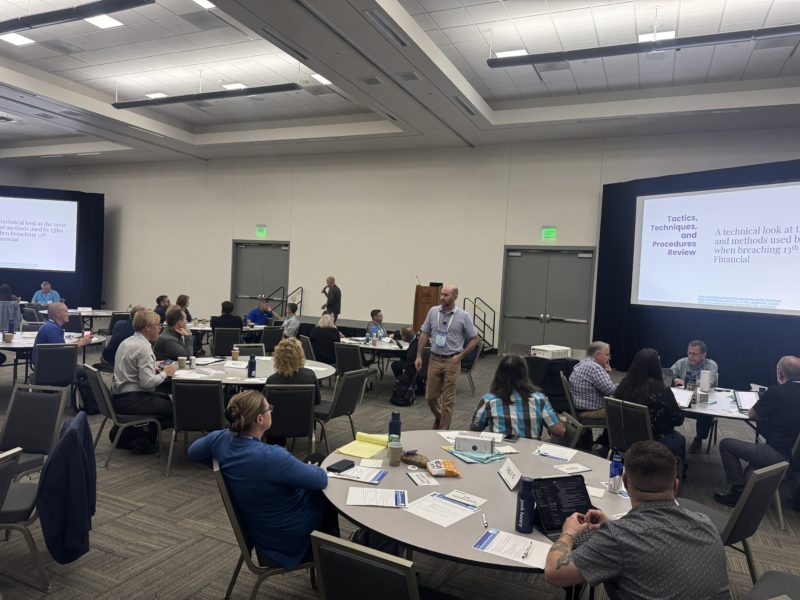
Over the past few years, our Rebyc Security team has conducted its own grassroots analysis at the Cybersecurity Forums we’ve delivered with our partner, Jack Henry & Associates. At each of the 6–8 annual events we host across the country, we ask attendees what their top cybersecurity concerns are—and across more than 30 events, the number one answer has consistently been phishing.
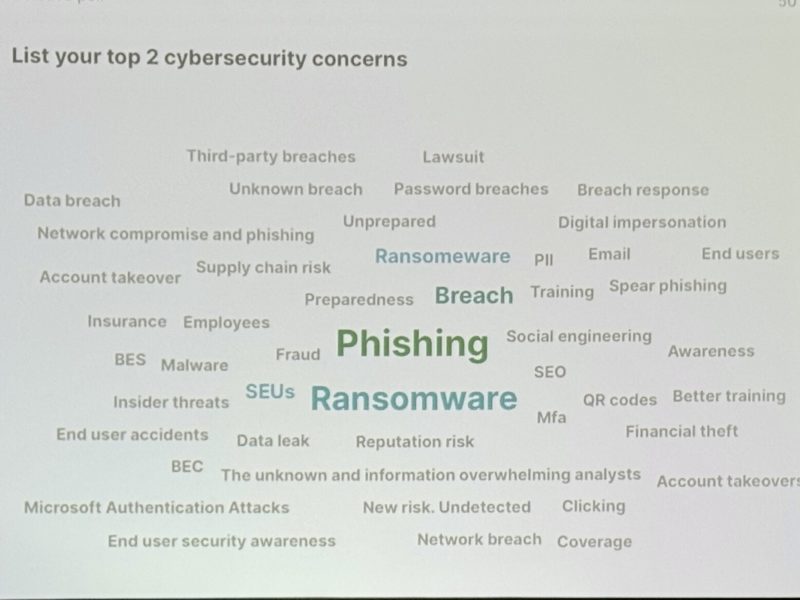
Multiple threat intelligence reports also indicate that global phishing activity increased by more than 15% year-over-year in 2025, driven by phishing-as-a-service (PhaaS) platforms, automation, and the rapid adoption of generative AI by attackers.² These campaigns now routinely incorporate AI-generated content, deepfake voice techniques, QR code phishing, and adversary-in-the-middle (AiTM) frameworks—reinforcing the importance of realistic phishing testing that reflects how real attackers operate today.³
Why Phishing Looks Different in 2026
Phishing threats in 2026 have evolved far beyond basic email scams, incorporating omni-channel approaches, phishing-as-a-service (PhaaS) kits, and AI-driven innovations. Below are the primary ways modern phishing attacks are adapting:
- AI-generated phishing emails and content:
Security researchers report that AI-assisted phishing activity increased significantly in 2025, with most modern phishing campaigns leveraging AI for personalization or payload generation.⁴ Traditional red flags like spelling errors are obsolete; instead, attackers exploit organizational context to craft spear-phishing that evades detection. - Search-engine poisoning and malicious ads:
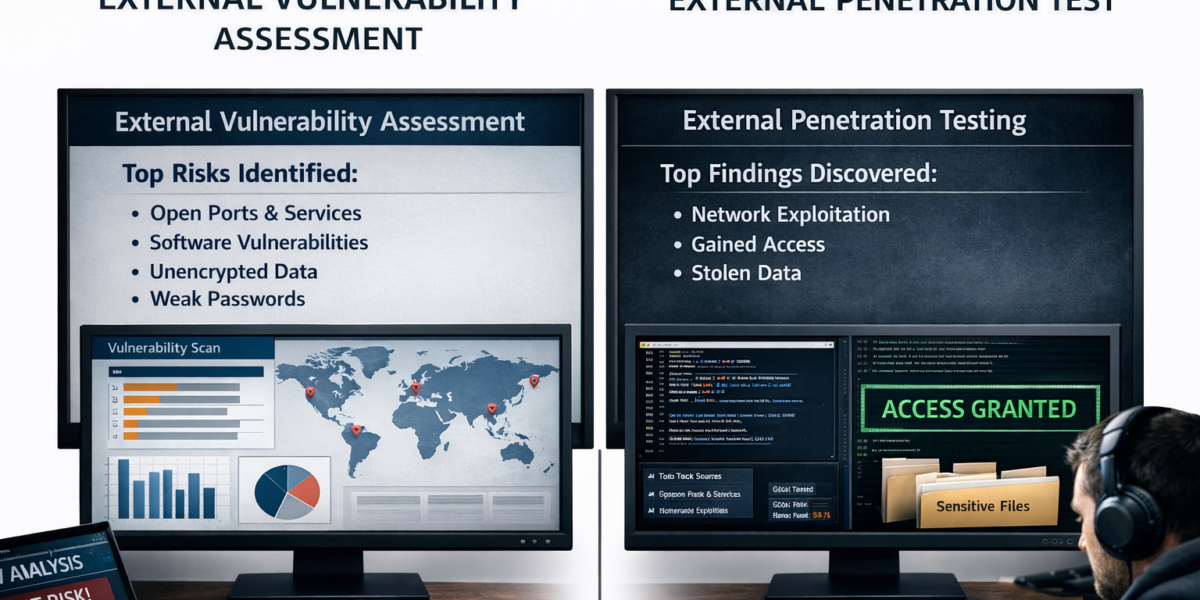
While approximately one-quarter of all emails are now malicious or unwanted, phishing threats increasingly originate outside the inbox.⁵ Threat intelligence from major security vendors shows a growing portion of phishing interactions originating from SEO-poisoned search results and compromised paid advertisements, where attackers manipulate rankings or purchase malicious ads that impersonate trusted brands and login portals. These attack paths are frequently identified during external penetration testing, where impersonation domains and credential-harvesting sites are uncovered. - Supply-chain and omni-channel phishing:
Compromised SaaS platforms, collaboration tools such as Slack or Microsoft Teams, and supply-chain accounts now fuel more than half of phishing attacks originating from hijacked legitimate sources.⁶ These omni-channel tactics blend email, SMS (smishing), and social media to create seamless and highly convincing deception. - Vishing and deepfake voice scams:
Phone-based attacks surged in 2025, with security providers reporting a dramatic increase in phishing campaigns using phone numbers as the primary payload.⁷ In 2026, real-time AI voice impersonation is expected to expand further, enabling attackers to convincingly mimic executives, vendors, or support staff to apply urgency and authority. - QR code phishing (QRishing):
QR codes have exploded in popularity as a phishing delivery mechanism. Threat research shows that a large percentage of malicious PDFs and Microsoft 365 documents now contain embedded QR codes that redirect users to credential-harvesting sites, effectively bypassing traditional email filtering controls.⁸ - AiTM attacks and session token theft via tools like Evilginx:
Adversary-in-the-middle frameworks such as Evilginx act as reverse proxies, intercepting credentials, MFA responses, and session tokens during login. This technique allows attackers to hijack sessions post-authentication, rendering traditional MFA ineffective. Incident response reporting in 2025 linked Evilginx-style attacks to targeted campaigns against Entra ID, Gmail, Outlook, and financial services organizations—often resulting in full compromise in under an hour.⁹
With phishing-related breaches now averaging nearly $5 million in cost and billions of malicious emails sent daily, organizations must adapt their defenses to match the reality of modern phishing threats.¹⁰
Below are updated best practices for 2026 to combat evolving phishing techniques, including AiTM attacks and session token theft.
5 Do’s for Phishing Prevention in 2026
- Scrutinize context, urgency, and multi-channel consistency
AI has eliminated grammatical red flags. Evaluate whether the request aligns with normal workflows, roles, and timing. For vishing or suspected deepfakes, verify authenticity by asking non-scripted questions. - Verify requests through independent channels
For any request involving funds, sensitive data, or credentials—even if it appears legitimate—confirm via a separate, trusted channel such as a known phone number or in-person verification. - Adopt phishing-resistant MFA and zero-trust controls
Move beyond OTP-based MFA to FIDO2 hardware keys or passkeys, which are resistant to Evilginx-style interception. Pair authentication with conditional access and continuous monitoring for anomalous logins.¹¹ - Scan QR codes and links with caution
Avoid scanning unexpected QR codes in emails or documents. Manually navigate to known URLs or use security tooling to preview destinations before interacting. - Report incidents immediately and train continuously
Prompt reporting enables rapid blocking and threat hunting. Security awareness programs have been shown to significantly reduce phishing failure rates over time when reinforced with regular simulations and feedback.¹²
5 Don’ts to Avoid the Latest Phishing Threats
- Don’t engage with suspicious messages
Responding confirms activity and often triggers follow-on spear-phishing, vishing, or impersonation attempts. - Don’t share credentials, MFA tokens, or session details
Legitimate organizations do not request these via email, chat, phone, or QR codes. Session token theft enables instant account takeover. - Don’t trust search results, ads, or unsolicited links blindly
SEO poisoning and malicious advertising are increasingly common phishing entry points. - Don’t open unexpected attachments or scan unknown QR codes
PDFs, Office documents, and QR-embedded files remain common delivery methods for phishing and malware. - Don’t handle incidents alone if compromised
Delayed reporting often leads to escalation. Rapid response has been shown to significantly limit attacker dwell time and overall impact. Attackers consistently look for low-resistance targets.
Phishing has evolved from a nuisance into a strategic attack vector that blends technology, psychology, and speed. As attackers continue to leverage AI, trusted platforms, and identity-based techniques, defensive tools alone are no longer enough. Organizations must understand not just whether users click—but what happens next when credentials, sessions, or trust are abused.
Assessing phishing resilience in 2026 requires thinking like an attacker, validating assumptions through real-world testing, and continuously adapting to how threats actually unfold. That offensive mindset is what separates organizations that merely detect phishing attempts from those that truly withstand them.

Inline Footnotes
- Verizon, Data Breach Investigations Report (DBIR)
- APWG, Phishing Activity Trends Reports
- Microsoft, Digital Defense Report
- Proofpoint, State of the Phish
- Cisco Talos email telemetry
- Microsoft, Digital Defense Report; Proofpoint research
- Proofpoint; Cisco Talos
- HP Wolf Security, Threat Insights Report
- Microsoft and Mandiant incident response reporting
- IBM, Cost of a Data Breach Report
- FIDO Alliance; Microsoft Entra ID guidance
- KnowBe4; SANS Security Awareness Research